Daily-life decisions
Recognize meaningful patterns in purchases, personal finance, digital safety, driving, and other choices made under uncertainty.

Your Decision Profile
SignalScore reveals how well you detect meaningful signals—and how your decision style shapes the choices you make.
What SignalScore reveals
SignalScore examines how you distinguish meaningful evidence from background noise—and the threshold you use before deciding to act.
Recognize meaningful patterns in purchases, personal finance, digital safety, driving, and other choices made under uncertainty.
Understand how you interpret incomplete information, emerging risks, competing priorities, and operational warning signs.
See whether your decision threshold tends toward early action, balanced judgment, or waiting for stronger evidence.
Theoretical Foundation
Signal Detection Theory explains decisions made when useful evidence overlaps with ordinary background noise. Because the two are rarely separated perfectly, every judgment involves both the ability to distinguish them and a threshold for deciding when enough evidence is present.
Sensitivity (d′) describes how clearly signal-present situations can be separated from signal-absent situations. Criterion (c) describes where a person places the decision threshold before saying that a signal is present.
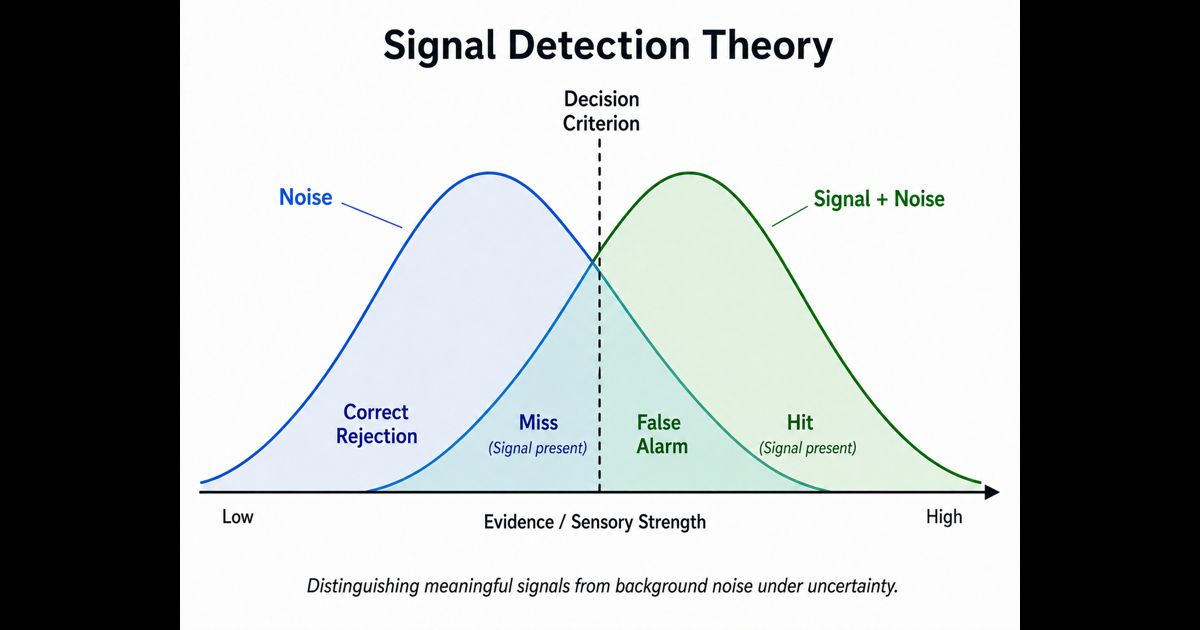
Your result combines signal-detection sensitivity with decision-criterion alignment. It is developmental insight—not a psychological or employment test.
Human judgment assessment
Choose an assessment and make 16 evidence-based decisions. Your SignalProfile will show how effectively you distinguish meaningful patterns from noise—and the threshold you use to act.
Evaluation release. Results are developmental and are not a validated psychological, employment, selection, medical, legal, driving, or financial assessment.
Before you begin
Your decisions, confidence ratings, and response times will be stored for research and product evaluation. Profile questions are optional. Results must not be used for consequential decisions.
Balancing domains, difficulty, and signal status…
Subdomain
Is there a meaningful signal that warrants attention?
SignalScore summarizes how effectively you separated meaningful signals from noise while accounting for how balanced your decision threshold was. Higher values indicate stronger overall signal discernment on this scenario bank.
Range: 0–100
Your signal profile
d′ measures how distinctly you separated signal-present scenarios from signal-absent scenarios. A larger positive value indicates clearer discrimination; values near zero indicate difficulty distinguishing the two.
Range in this assessment: approximately −3.19 to +3.19
Range: 0–100
Range: 0–100
Recorded range: 0–3,600 seconds; no value is inherently better
c describes where you set the threshold for saying a signal was present. Negative values indicate a more action-leaning threshold, positive values indicate a more evidence-leaning threshold, and values near zero indicate a balanced threshold.
Range in this assessment: approximately −1.59 to +1.59
You are more willing to act when the evidence is still limited. This can help you catch subtle or early signals, but it can also produce more false alarms.
You prefer stronger evidence before deciding that a signal is present. This can reduce false alarms, but subtle or early signals may sometimes be missed.
SignalScore combines sensitivity and criterion alignment into a single developmental result. Confidence and response time are reported separately and do not affect SignalScore.